
Active Warrants in Lee County
An active warrant is simply court process that has been issued but not yet served, recalled, or quashed. Lee County publishes no public name-search list of that process. The sheriff's website does carry agency contacts, reports, tips, and recent-arrest information, but no active-warrant roster appears anywhere on it. That silence fits the sheriff's access policy, which bars release of unexecuted arrest warrants and open investigative material. It also means nobody can honestly quote a list count, a refresh schedule, or a status filter for Lee County. Confirm through the issuing court first, then use the sheriff's in-person route for county confirmation, and verify any old docket reference before you act on it.
No Lee County Active List
The direct answer stands: the Lee County Sheriff publishes no public active-warrant list, no outstanding-warrant spreadsheet, and no current most-wanted roster. A missing roster is not missing warrants, though. Agencies keep operational data the public cannot browse, and Alabama law actually requires them to report unserved arrest-warrant data to ALEA. That state exchange never becomes public access. The Ala. Code §41-9-627 page lays out the agency duty to report unserved warrants and any later service or withdrawal.
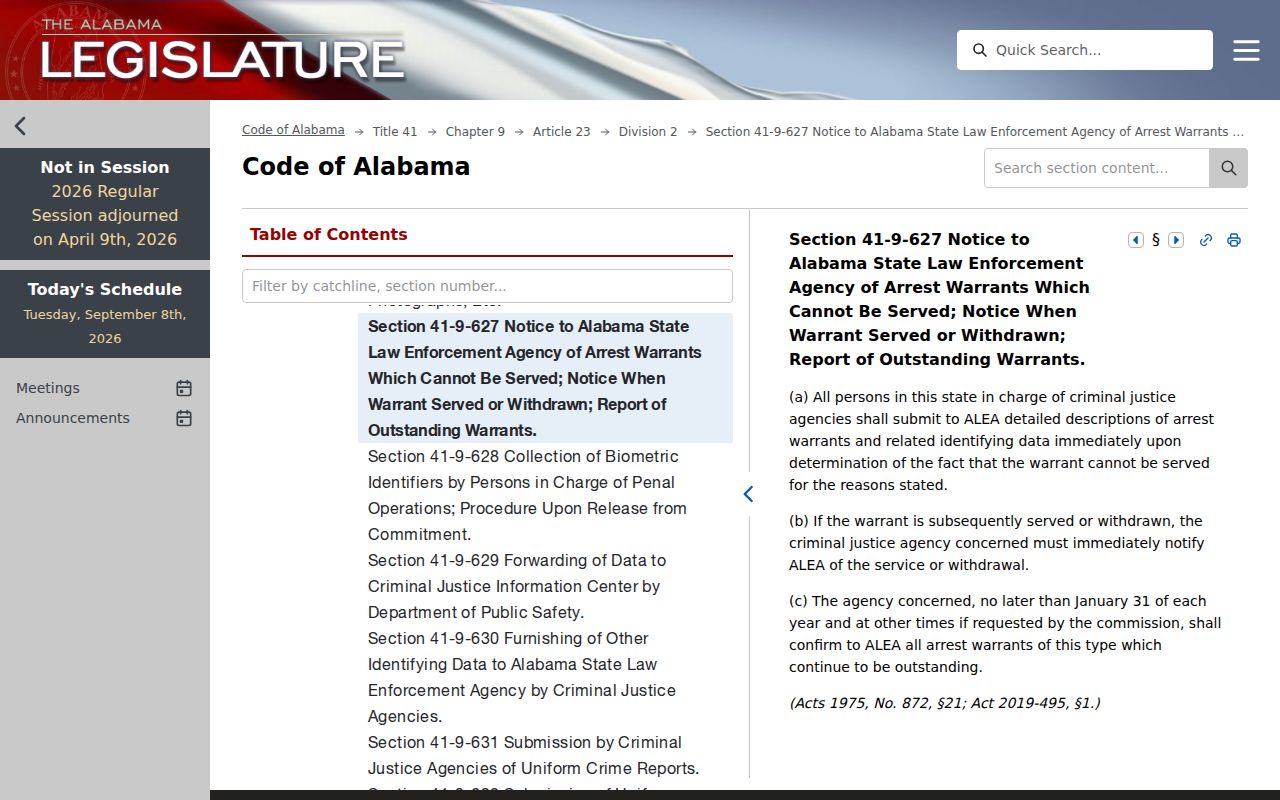
The code text describes an agency reporting layer, not a Lee County public warrant-search portal.
Key Point: Do not treat a commercial people-search page, an old news post, or a blank docket as an official Lee County active-warrant check.
Confirm your own status with the issuing court or the sheriff route described by the county magistrate.
That line matters for accuracy and lawful access alike. It also keeps a stale or unrelated Lee County record from being read as a live court command.
How the Lee County Active Warrant List Works
No public Lee County list exists, so there is no refresh schedule to describe. A county warrant usually starts with a complaint, an incident report, a sworn deposition, and a magistrate's probable-cause finding. Miss court, and a bench or alias warrant may follow. Auburn and Opelika each keep their own city dockets. Those streams never merge into one index just because the sheriff may later serve a warrant or the county jail may hold the person.
Note: Lee County posts no update schedule, and a name missing from public view cannot prove no warrant exists.
A warrant named in an older Lee County record may already be served or recalled. Only the issuing court can confirm its current status. The sheriff offers the county confirmation route its policy allows.
Auburn Active Warrants Stay Local
Auburn Municipal Court handles city traffic, ordinance, adopted misdemeanor, citizen-warrant, probation, and failure-to-appear cases. Its calendar runs citizen-warrant cases and probation or general reviews on Tuesdays, traffic on Wednesdays, and first appearances and trials on Thursdays. Call the court at (334) 501-3180 and name the docket type. The official Auburn court page shows that schedule and contact path, and it explains why an Auburn warrant can require city-court contact even after Lee County law enforcement gets involved. Auburn's police page lists public-safety contacts and record links but no warrant-search form.
What a Lee County Active Warrant Shows
Lee County publishes no listing schema, but Alabama warrant forms and local procedure still show what a record typically holds. A court file may include the court and county, the subject, a case or citation reference, a warrant label, the charge or ordinance, the probable-cause or failure-to-appear basis, judicial authorization, a service return, and court-set bond information. Access to each item depends on case status and confidentiality rules.
| Reference | A case or warrant identifier; no public Lee County numbering format was verified. |
|---|---|
| Warrant label | Arrest, bench, alias FTA, probation, release-order, or another authorized process. |
| Issuing court | The Circuit or District Court, Auburn Municipal Court, or Opelika Municipal Court. |
| Trigger | A probable-cause finding, missed setting, or claimed failure to comply. |
| Status and bond | Service or recall information and any release condition the court has set. |
A Lee County active warrant marks court business that is still open and has not been completed or withdrawn.
Lee County Service and Bond
Issuance, service, custody, and bond are four separate steps. A magistrate or judge issues the warrant. The sheriff or city police serve it. Processing may then happen at the Lee County Detention Center, while the originating court still owns the case. Auburn posts the clearest bond guidance: many new arrests qualify for signature bonds, but failure-to-appear and out-of-state defendants must post bond on all charges before release. The Auburn bond page identifies cash, licensed bail-company, and qualifying property-owner routes, though those rules govern municipal matters, not a countywide schedule. Bond secures release and future appearance. It does not erase the charge. A forfeiture is a loss or judgment tied to missing court, subject to court procedure.
Lee County Most-Wanted and Roundups
The Lee County Sheriff posts no current most-wanted roster, reward schedule, or warrant-roundup page. A general tip path exists, and Auburn and Opelika run public-safety news and tip channels. None of those are warrant databases, so treat them as leads rather than answers.
Key Point: The official sheriff website is the correct place to check current agency links and submit a general tip.
For the distinction between a curated public-safety program and all outstanding process, see the Lee County most-wanted reference.
An old Opelika court-forgiveness program shows how one Lee County city once cleared cases, but it is not a live 2026 amnesty offer. Call Opelika Municipal Court before trusting any dated announcement.
Auburn Active-Warrant Contact Route
Auburn sits in Lee County, and its police share quarters with Municipal Court at 141 N. Ross Street. The public-safety office answers at (334) 501-3110. For non-emergencies, dial (334) 501-3100. The court, not the police desk, holds the answer on city-case status and remedy, so bring your full legal name, birth date, citation or case number, and photo ID when the court gives instructions. The official Auburn Police page lists public-safety contacts and records routes, though it carries no active-warrant database. A police phone call and a court check answer different questions. Ask the court how to handle its warrant before any unplanned appearance in Lee County.
Payment Does Not Prove Clearance
A receipt only proves money reached a court vendor. It does not prove a Lee County warrant was recalled. Auburn stopped taking city credit-card payments directly. FivePoint now handles some traffic, payment-plan, and parking payments, and a court-lobby kiosk works during normal hours. The vendor charges $3 or 3.5 percent, whichever is higher. Those are Auburn terms, not Lee County records fees or bond terms. The official Auburn payment instructions spell out the vendor and kiosk route. Ask the court whether payment is even allowed, and whether an FTA warrant needs its own court action. Keep the receipt and any new setting in writing. Then have the clerk confirm the warrant's current status.
If Your Name Is on the List
When an official confirms an active warrant, get four things: the court, the case number, the warrant type, and the permitted next step. Talk to a lawyer first. Do not surrender unplanned. Counsel may pursue a scheduled appearance, a walk-through surrender, bond, or a motion to recall or quash. Recall means the issuing court withdraws the warrant; quash means it nullifies that process outright. Never assume either happened because you paid or the listing vanished online. Lee County publishes no single surrender counter, recall form, amnesty calendar, or bond schedule. Auburn, Opelika, and county cases each run through different contacts. For the wider court-first route, see Lee County warrant resolution steps, and for missed-court process, the bench-warrant information page helps.
Important: Seek legal advice before surrender. An active warrant can result in arrest during contact with law enforcement.
After any appearance, get written or docket confirmation of service, recall, or other resolution in your Lee County case. The underlying case may stay open.